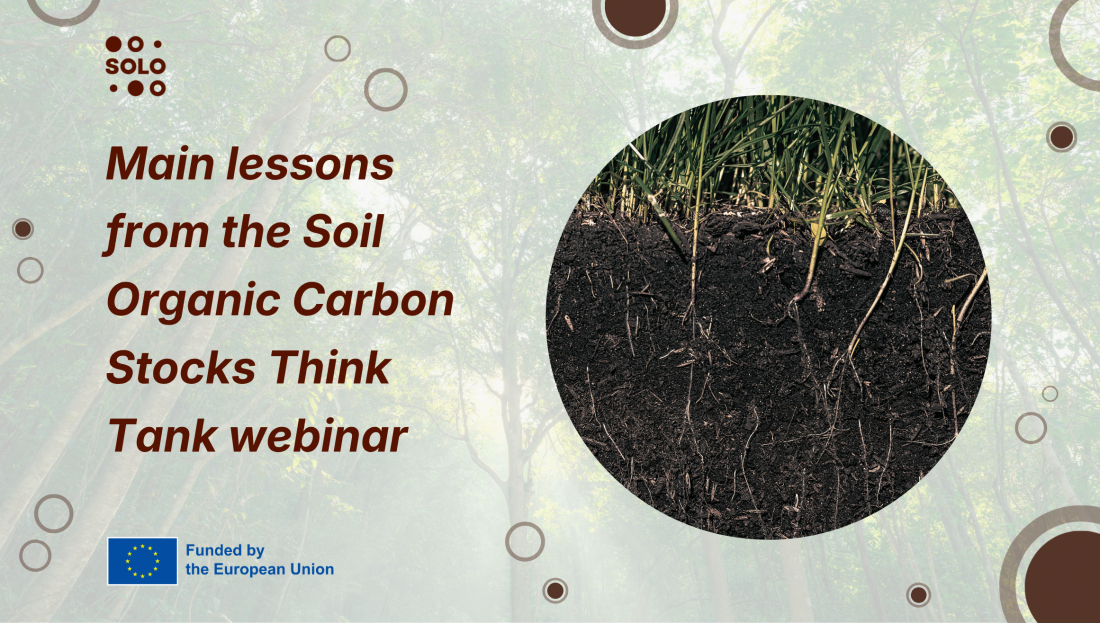
On June 17th, the Soil Organic Carbon Stocks (SOC) SOLO Think Tank organised a webinar to unveil a comprehensive "Soil Organic Carbon Stocks Roadmap," a strategic blueprint designed to help the European Commission conserve and increase SOC stocks. This roadmap addresses a critical environmental challenge: current data shows that European soils are a net source of greenhouse gas emissions, losing carbon through erosion and intensive management faster than they can store it.
The SOLO SOC Roadmap highlights a stark "carbon deficit" in the EU. While mineral soils currently capture 44 million tonnes of CO2 per year, cultivation and drainage of organic soils release a staggering 108 million tonnes of CO2 annually. With over 60% of EU soils currently affected by degradation, the roadmap identifies 10 critical "Knowledge Gaps" that must be bridged to achieve climate neutrality by 2050.
The Key Strategic Pillars of the roadmap - distilled through a rigorous process of expert reviews and stakeholder workshops in Sofia, Évora, and Hungary - focus on several high-priority areas:
Ecological Foundations: Researchers must shift from isolated climate mitigation models to climate adaptation strategies that integrate high-resolution mapping of below-ground microbial communities.
Managing Trade-Offs: The roadmap warns of "hidden trade-offs" in land management. For example, while practices like no-till farming can build topsoil carbon, they may unintentionally trigger nitrous oxide (N2O) emissions or nutrient mining. Similarly, forest management must shift away from prioritising timber and bioenergy toward holistic preservation of habitats and soils to prevent decadal SOC declines caused by uniformly cutting down and removing trees.
Preventing "Global Leakage": A major policy concern identified is that strictly prioritising carbon sequestration within the EU could accidentally drive deforestation and carbon loss abroad by increasing the Union's reliance on food imports.
Bridging the Technical and Social Gap to Move from Theory to Practice: The roadmap calls for a transition in how we measure soil health. It advocates for replacing slow, expensive lab analysis with rapid assessment tools. Furthermore, it emphasises the need for localised "knowledge brokers" to translate complex scientific research into tailored advice for land managers.
A Paradigm Shift: From Sequestration to Stewardship: The Roadmap concludes with a call for a fundamental shift in perspective. It warns against the "Sequestration Trap", treating soil merely as a static vault for atmospheric CO2. Instead, it promotes the Stewardship Paradigm, which recognises that soil organic matter is most biologically useful when it cycles and releases nutrients.
According to the FAO’s 2015 soil functions, "Soil carbon is not merely a climate mitigation accounting exercise; it is the essential driver of a multitude of ecosystem services,". By practicing active stewardship, the EU can secure food supplies, adapt to a changing climate, and protect the foundational engine of life on Earth. Soil health and the associated carbon are connectors among many agroecological principles, meaning that when the soil is cared for, other environmental and farming issues are positively impacted at the same time.
The webinar was also an opportunity to present agroecology as a framework to restore soil health and to sequester carbon. Marcos Lana, who is an associate professor at SLU - Swedish University of Agricultural Sciences, presented the contribution of agroecology to that matter. His “work focuses on the use of crop models to assess the impact of climate change and agronomic management on crop performance, to propose suitable adaptation strategies (...)”. Agroecology is the framework he promotes to support the transition towards sustainable farming systems.
Professor Lana first recalls that agroecology is a paradigm that aims to change food systems towards sustainability and resiliency based on 13 principles (or 10 elements), starting at the farm level. He emphasised that restoring soil health through sustainable farming is a gradual process rather than a quick fix. Because local soil and climate conditions (pedoclimatic contexts) vary so much, farming practices must be specifically tailored to each location. The farm must be accompanied in its transformation by, among other things, policy and financial support, consumers’ acknowledgement and support, exchange with other farmers, and specific advisory services.
Restoring agricultural soils while ensuring that they can contribute to climate mitigation by sequestering carbon means a great redesign of farming and food systems structures. Professor Lana participated in the webinar to demonstrate that agroecology offers a great systemic approach to achieve this transformation.