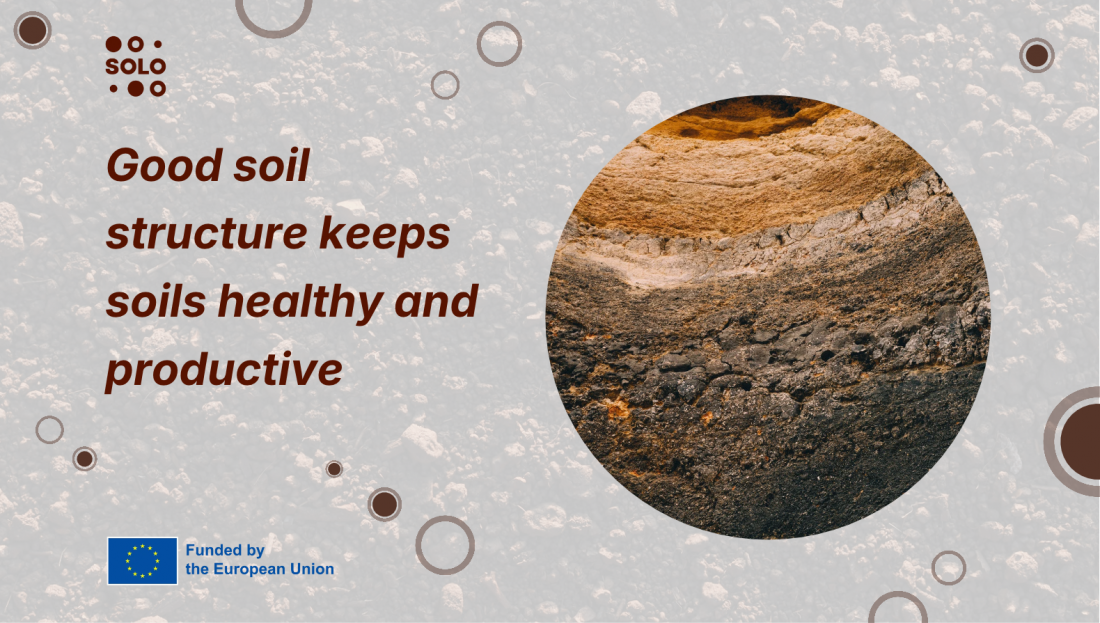
The “Improve Soil Structure” webinar, presented by Jenni Hultman from Luke, introduced the work of the SOLO Improve Soil Structure TT. The work was conducted together with Taina Pennanen, Helena Soinne, Antti-Jussi Lindroos, and Tiina Törmänen. The webinar highlighted soil structure as a foundation for healthy soils and for ecosystem services including food and biomass production, water purification, nutrient cycling, carbon storage, and biodiversity.
The webinar presented the development of a roadmap for improving soil structure. It builds on an earlier scoping document concerning knowledge gaps and was refined through work with stakeholders in SOLO meetings, discussions with Luke personnel, online meetings with stakeholders, and different cross-fertilization events. During this process, the initial set of ten knowledge gaps was reduced to eight.
During the webinar, three priority knowledge gaps were emphasized. The first concerned climate change and water regulation, particularly how soil structure can support water regulation and habitat provision under changing climatic and land-use conditions. Proposed actions included simpler measurements of soil water-holding capacity, improved observation across scales and land uses, models using indicators and sensors, and decision-support systems helping farmers conduct operations at appropriate times.
The second priority was the quantification and valuation of soil structure. The webinar called for harmonized measurements, standardized indicators and benchmarks, better use of existing databases, and integration of different data sources to support modelling and machine-learning applications. It also emphasized the need to recognize the economic value of the ecosystem services supported by soil structure.
The third priority addressed the interactions among biological, physical, and chemical soil factors. Further research is needed to understand how these interactions build and maintain soil structure and how they can be managed to enhance long-term structural resilience. Evidence-based guidance tailored to different land uses was identified as an important practical outcome.
Additional knowledge gaps covered forest management and disturbances, circular-economy-derived soil amendments, changes in climate and the operational environment, soil compaction and sealing, knowledge transfer to land managers, and supply-chain pressures that may force farmers to enter fields under unsuitable conditions.
Key takeaways
The webinar demonstrated that improving soil structure requires coordinated research, harmonised monitoring, practical management tools, education, and attention to economic and societal conditions. Because soil structure underpins soil biodiversity, carbon storage, water regulation, and several other soil functions, future actions should be coordinated across the SOLO Think Tanks to generate complementary benefits and avoid fragmented solutions.